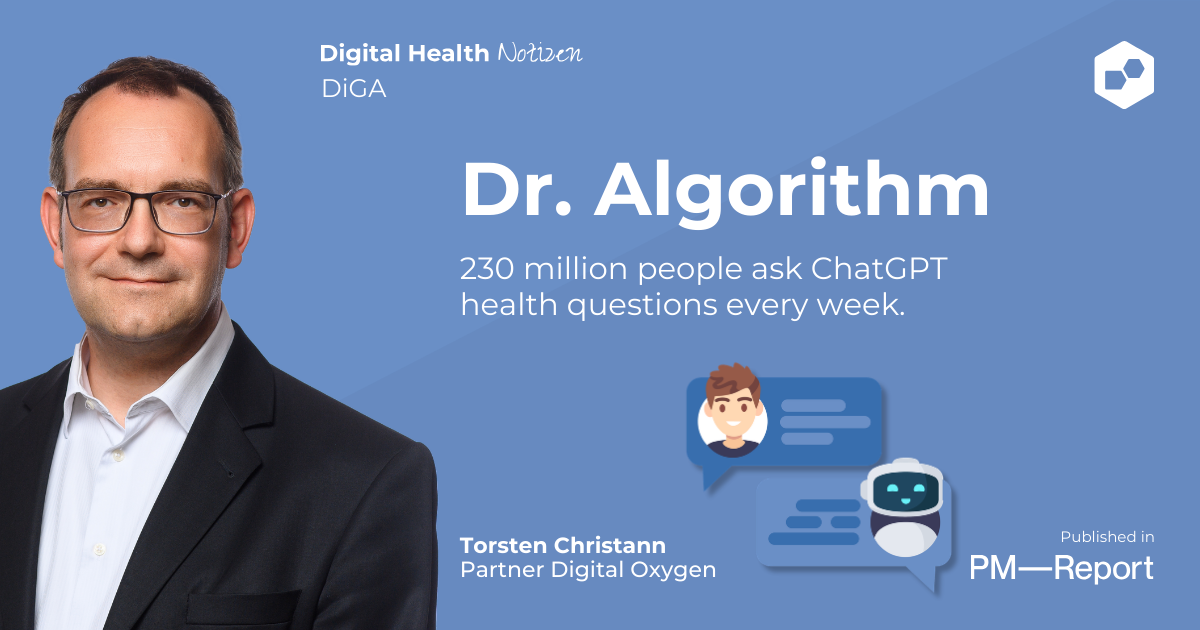
Dr. Algorithm invites you to his consultation.
Dear readers,
It’s great to have you join me once again as we browse through my Digital Health Notes together.
The other night, at half past midnight, I found myself sitting in front of my laptop with a sore throat and a mild fever, facing an existential question: Should I google my symptoms? With the risk that after twelve minutes I’d be convinced I was either about to die or at least patient zero of a new pandemic.
According to a recent report by OpenAI, around 230 million people ask ChatGPT health-related questions every week. And now the company is planning a dedicated product: ChatGPT Health.
What’s happening here is bigger than just a more convenient symptom checker. AI-driven systems are making medical knowledge available around the clock – accessible, language-adapted, without waiting rooms and without appointments.
For people with limited access to healthcare, this is revolutionary. For overstretched health systems, it may even offer relief. But for all of us, it is also a double-edged sword.
Because one thing is clear: ChatGPT Health does not replace a doctor. It simulates one.
The system does not understand disease. It recognizes patterns in text. It does not know what lungs sound like. It cannot smell ketones on the breath. It cannot see a rash. It only sees words.
And in medicine, words are notoriously unreliable.
“I feel dizzy” could mean dehydration.
Or a stroke.
Between empowerment and overconfidence
Supporters argue that informed patients are better patients. Those who assess their symptoms in advance enter conversations with doctors more structured. Those who understand side effects better understand their therapies. And those who have medical terminology translated into everyday language feel taken seriously.
All of that is true.
But AI also creates a false sense of certainty. The answers are calm, logical and linguistically confident. That is precisely what makes them so convincing – and potentially so dangerous.
We tend to confuse well-formulated responses with factual accuracy.
If a machine says, “This sounds more like a harmless viral infection,” that can be reassuring. Perhaps too reassuring.
Medicine thrives on uncertainty, probabilities and clinical experience. AI thrives on data patterns. These are not the same thing.
The underestimated risk: our most intimate data
Health is one of the most sensitive categories of data we have.
Anyone feeding ChatGPT Health with symptoms, diagnoses, medication plans or mental health concerns is sharing more than just information – they are sharing vulnerability.
OpenAI promises encrypted storage and separation from other chats. That sounds reassuring. But even the highest security standards cannot eliminate real risks: data breaches, cyberattacks and technical failures are part of digital reality.
And unlike a forgotten password, health data cannot simply be reset.
A mental health diagnosis or genetic risk does not disappear just because we click “log out.”
The crucial question therefore is not only: How good is the medical advice?
It is also: Where does my data end up – and what happens if it does not stay there?
The fact that GPT Health has not yet been announced for Europe is probably no coincidence. The GDPR and European medical device regulations are not exactly friendly playgrounds for rapid product launches.
Who carries the responsibility?
If a doctor makes a mistake, there are liability rules, clinical guidelines and professional regulations.
If ChatGPT Health makes a mistake, there is an update.
Responsibility is politely handed back to the user: “Please consult a healthcare professional in case of serious symptoms.” Legally sound. Socially unsatisfying.
Because realistically, people will not only use AI as a source of information – they will use it to help make decisions.
Especially when they are uncertain.
The real potential
And yet the potential is enormous.
AI can translate medical information into understandable language, structure therapy plans, remind patients to take medication in chronic conditions, answer questions people may hesitate to ask their doctor, or help interpret a second opinion.
Used correctly, ChatGPT Health could become a navigation system through a complex healthcare system.
Not a replacement for physicians – but an intelligent guide.
The key question is therefore not: Should AI be allowed to answer medical questions?
The real question is: How do we integrate it responsibly into existing healthcare structures?
Conclusion: between digital family doctor and dangerous illusion
ChatGPT in healthcare is neither a miracle cure nor a threat. It is a tool.
The real problem is not the AI itself. The problem is our tendency to mistake eloquence for competence.
Perhaps the doctors of the future will not compete with AI, but interpret it.
Perhaps medical expertise will increasingly include knowing when to trust the machine – and when not to.
And until that day arrives, it might not be such a bad idea that when I feel sick at half past midnight, I am not sitting in front of my laptop but lying in bed, recovering the old-fashioned way.
In that spirit: stay healthy. And stay critically curious.
Until next time,
Torsten Christann