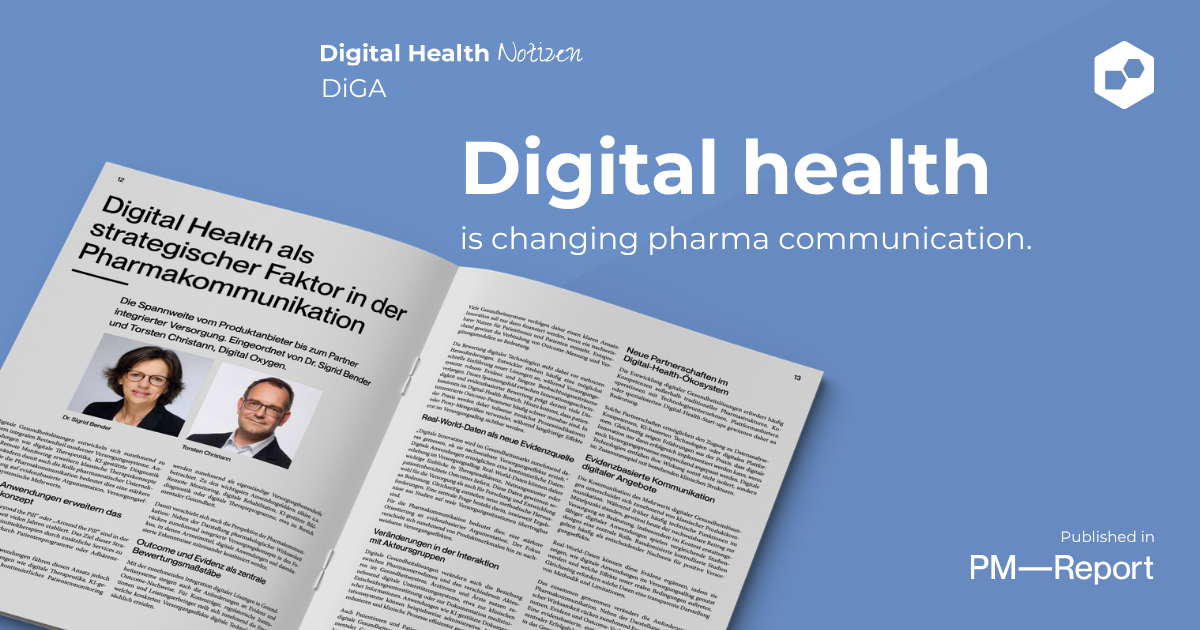
From Product Provider to Partner in Integrated Care
By Dr. Sigrid Bender and Torsten Christann, both at Digital Oxygen
Teaser
Digital health solutions are increasingly becoming an integral part of modern healthcare systems. Applications such as digital therapeutics, AI-supported diagnostics and remote monitoring are expanding traditional therapy concepts and changing the role of pharmaceutical companies. For pharma communication, this means a stronger focus on evidence-based argumentation, healthcare outcomes and systemic value.
Digital Applications Expand the Therapy Concept
Concepts such as “Beyond the Pill” or “Around the Pill” have been established in the pharmaceutical industry for many years. The aim of these strategies is to support drug therapies with additional services, such as patient programs or adherence offerings.
However, digital health applications are taking this approach into a new phase. Solutions such as digital therapeutics, AI-supported diagnostics or continuous patient monitoring are increasingly being viewed as independent components of care. Key areas of application include remote monitoring, digital rehabilitation, AI-supported image diagnostics and digital therapy programs, for example in the field of mental health.
This also shifts the perspective of pharma communication. In addition to communicating pharmacological efficacy, the focus is increasingly moving toward integrated care concepts in which medicines, digital applications and data-based insights are combined.
Outcomes and Evidence as Key Evaluation Criteria
As digital solutions become increasingly integrated into healthcare systems, the requirements for evidence and outcome data are also rising. For payers, regulatory institutions and healthcare providers, the central question is increasingly what concrete healthcare effects digital technologies actually achieve.
Many healthcare systems are therefore following a clear principle: innovation should only be funded if it creates demonstrable benefit for patients. As a result, the link between outcome measurement and reimbursement models is becoming increasingly important.
The evaluation of digital technologies faces several challenges. Developers often aim to bring new solutions to market as quickly as possible, while healthcare systems require robust evidence and longer observation periods. This tension between innovation speed and evidence-based evaluation currently shapes many discussions in the digital health sector.
In addition, patient-centered outcome parameters are often difficult to measure. In practice, process indicators or proxy measures are therefore sometimes used initially, while long-term effects only become visible in real-world care.
Pull Quote
“Digital innovation in the healthcare market is increasingly being measured by whether it achieves demonstrable healthcare outcomes.”
Real-World Data as a New Source of Evidence
Digital applications enable continuous data collection in everyday care. Real-world data can therefore provide important insights into therapy adherence, usage patterns and patient-reported outcomes.
These data are becoming increasingly important for both healthcare delivery and research and development. At the same time, new methodological challenges are emerging. One key question is the extent to which results from studies can be transferred to real-world care settings.
For pharma communication, this means a stronger orientation toward evidence-based argumentation. The focus is increasingly shifting from product features to demonstrable healthcare outcomes.
Changes in Interaction with Stakeholder Groups
Digital health solutions are also changing the relationship between pharmaceutical companies and the various stakeholders in the healthcare system.
Physicians are increasingly using digital support systems, for example for clinical decision support or the documentation of medical information. AI-supported documentation systems, for instance, can reduce administrative tasks and make clinical processes more efficient.
Patients are also increasingly using digital health offerings, particularly in the areas of mental health or self-management of chronic diseases. This creates new communication channels along the entire therapy process.
For pharma communication, this means a shift from selective product information toward continuous, dialogue-oriented interaction.
New Partnerships in the Digital Health Ecosystem
The development of digital health solutions often requires capabilities outside traditional pharmaceutical structures. Partnerships with technology companies, platform providers or specialized digital health start-ups are therefore becoming increasingly important.
Such partnerships provide access to data analytics expertise, AI-based technologies and digital platforms. At the same time, practical experience shows that digital innovation can only be successfully implemented if care processes are adapted accordingly.
Digital technologies therefore do not create impact in isolation, but in interaction with existing clinical structures.
Evidence-Based Communication of Digital Offerings
Communicating the value of digital health solutions is increasingly different from traditional product communication. While technical features were often the main focus in the past, the demonstrable contribution to healthcare is now becoming more important.
Comparative study designs play a central role, particularly in the context of reimbursable digital applications. Randomized controlled trials are often considered a decisive form of evidence for positive healthcare effects.
Real-world data can complement this evidence by showing how digital applications are used in everyday care and what effects occur under real-world conditions. At the same time, such data require transparent presentation of methodology and limitations.
Conclusion
Digital health solutions are increasingly becoming an important part of modern healthcare systems. Applications such as digital therapeutics, remote monitoring and AI-supported diagnostics are expanding traditional therapy concepts and opening up new opportunities to improve treatment outcomes.
This also changes the requirements for pharma communication. In addition to presenting pharmacological efficacy, questions of healthcare value, evidence and outcome improvement are increasingly moving into focus.
Evidence-based, system-oriented communication is therefore becoming a key success factor for the integration of digital innovations into the healthcare system.
Sources
- IQVIA Institute for Human Data Science: Stakeholder Strategies to Capitalize on Digital Health Innovation.
- Federal Institute for Drugs and Medical Devices (BfArM): Digital Health Applications (DiGA) – Fast-Track Procedure and Evidence Requirements.
- Busse R. et al. (2022/2025): Digital Health Applications (DiGA) in Germany – Evidence Requirements and Market Development. BMC Health Services Research; Volume 23, article number 369, 2023.
- International Journal of Technology Assessment in Health Care: Evidence generation for reimbursement of digital health applications in Germany. Cambridge University Press, 23 December 2022.
- SAGE Health Policy / Diabetes Technology & Therapeutics: The German Fast-Track Toward Reimbursement of Digital Health Applications. Journal of Diabetes Science and Technology 2024, Vol. 18(2), 470–476.
- Digital Healthcare Act (DVG) / Digital Act (DigiG).
- GKV-Spitzenverband (2025): Report on the Use and Development of Care with Digital Health Applications.